

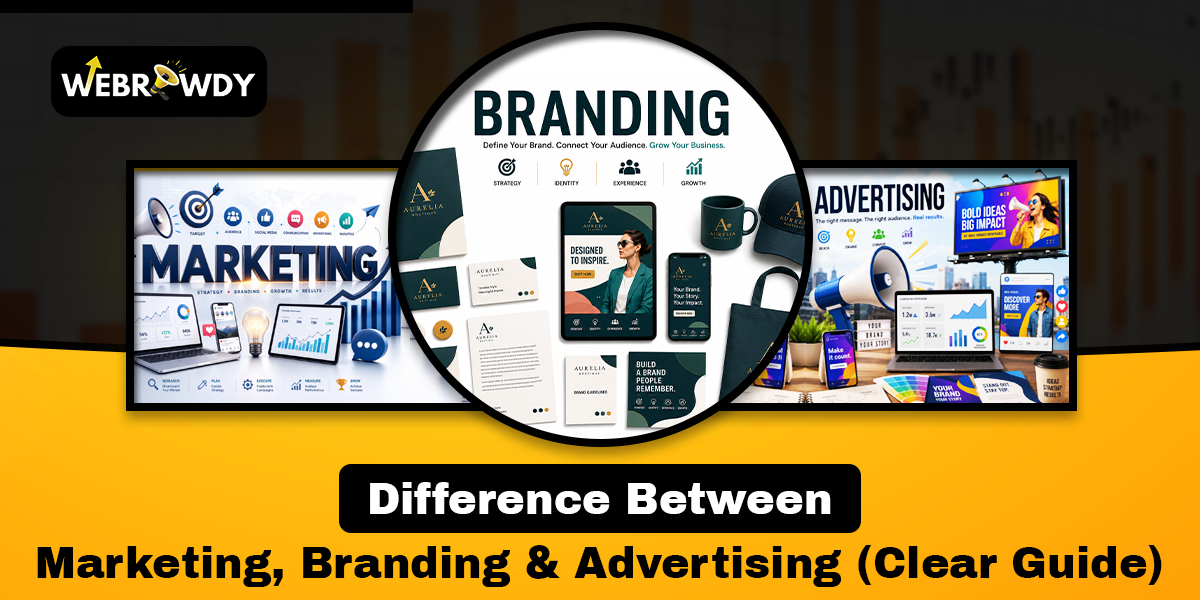
Running a successful business in this competitive world is not easy anymore. Often, businessmen are confused about finding the difference between marketing, branding, and advertising, which may lead to backlogs. Each of these terms serves different purposes, like branding shapes identity, marketing creates demand, and advertising spreads messages. Getting these strategies with WebRowdy in the right way takes down the consistent growth.
Understanding Each Marketing, Branding, and Advertising in Detail
A comprehensive understanding of this terminology, with examples and other factors, helps you to make better decisions and know whether they are running in the right direction or not. Let’s spend some time understanding these important breakdowns.
What is Branding? Explained With Example
Branding is all about the representation of the company, or you could say “identity”—how people perceive it. It shows how your audience is connected personally and emotionally, which builds their trust and creates engagement. Under branding, businesses use elements like logos, colors, tone of voice, and values to answer questions like:
- What does your company stand for?
- How does it speak? And,
- Why should customers trust it?
Having a good brand for a company means that customers have a positive feeling about the company. You can see successful branding companies such as Apple, Nike, and Coca-Cola. They choose the brand before the product.
Example
It can be clearly seen with Coca-Cola branding, which primarily focuses on togetherness and happiness. It connects with its audience by showing a red color, logo, and emotional ads. After seeing this branding, people prefer Coca-Cola with joy and happiness.
What is Marketing? Explained With Example
Marketing is the most important factor in revenue generation, which means the strategic process of promoting products or services to the right audience. You can see the different types of marketing strategies, all including research, communication, pricing, distribution, and content creation. It focuses on understanding customers and creating campaigns that attract, convert, and retain them.
Marketing and branding strategies vary in their fundamentals, as branding focuses on identity, while traditional marketing takes this one step further by attracting, converting, and retaining them.
Marketing is an ongoing, evolving strategy that depends on multiple factors, like
- Trends
- Customer behavior, and
- Competition
Its branches are digital marketing, social media marketing, content marketing, and email marketing, which benefit the company’s business.
Example
Some of the marketing and branding companies, like Amazon, attract and retain audiences by offering festival sales, Prime membership, rapid delivery options, and personalized product recommendations.
Understanding Advertising with an Example
Advertising is a consistent activity for companies within marketing. It mainly focuses on promoting the company’s services and products with the help of Meta Ads, Google Ads, outdoor hoardings, and television commercials. This factor is responsible for quickly delivering a clear message by paying for visibility.
When it comes to seeing marketing vs. advertising, the latter builds a strategy, and advertising amplifies the message in a larger context.
Example
The Nike company launched a campaign, “Just Do It,” featuring athletes like Michael Jordan and Serena Williams, which is a clear example of advertising. They help the Nike brand by promoting their products via digital platforms, TV Ads, and social media.
Key Differences Between Branding, Marketing, and Advertising
Today, most companies often rely on social media strategies due to their high effectiveness. Apart from these services, understanding the differences between them all will help you make informed decisions.
| Terms | Branding | Marketing | Advertising |
| Purpose | Generate identity, trust, and connect emotionally | Make strategy for connecting with the audience, engaging them, and drive action | Spread message, attract attention, and boost sales |
| Time | Long-term | Medium to long-term | Immediate/short-term |
| Aim | Perception, emotion, and consistency | Communication, strategy, and relationship | Promotion, visibility, and results |
| Scope | Overall values & brand experience | Campaigning, channels, and messaging | Ads & specific paid promotions |
| Result | Trust & loyalty | Customer engagement and conversations | Awareness, leads, and sales |
Why Choose WebRowdy For Your Business Growth
When it comes to SEO services and enhancing sales or overall growth for your restaurants and food businesses, WebRowdy has the potential to upscale them. They have specialized teams that make sure every corner gives the best outcomes.
Whether you need digital marketing for restaurants or any other services, they are always committed to offering what helps your business achieve success.
Conclusion
Businesses that understand the clear difference between marketing, branding, and advertising are achieving massive success compared to those who miss it. Each strategy has its own specific outcomes, which contribute to your restaurant and business success. WebRowdy supports transforming your business ideas into reality.
Frequently Asked Questions on the Difference Between Marketing, Branding & Advertising (Clear Guide):
Q1. Is only social media marketing sufficient for your business?
A1. No, it can help you to reach some people, but for global reach, you need professional help.
Q2. Is it necessary to collaborate with a professional SEO/Digital Marketing service provider?
A2. Yes, businesses that want to achieve their goals and build a worldwide identity require professional service providers.
Q3. Do branding, marketing, and advertising affect our leads?
A3. Yes, they have a direct connection with the number of leads your business is getting at present.
Popular Post
How to Get Your Brand Cited by ChatGPT, Gemini, and Perplexity in 2026
Holiday SEO Starts Now: A September Checklist for E-Commerce Stores
AI Search Optimization in 2026: What Businesses Need Beyond Traditional SEO